The Erosion of Agency: Why Autonomous Systems Require a Deterministic Infrastructure for Enterprise Security

The rapid integration of autonomous AI agents into enterprise workflows has created a significant security paradox: while these systems are designed to expand operational capacity, they simultaneously introduce an invisible, compounding risk profile. As agents accumulate tools, credentials, and network permissions, their actual power often drifts far beyond the original design intent. This phenomenon, which experts identify as "capability drift," occurs not through malicious intent but through the incremental, uncoordinated granting of permissions—a "permission creep" that renders traditional perimeter security obsolete.
The Anatomy of Capability Drift
In modern software development, agents are often deployed with a modular set of tools meant to solve specific tasks. A tool added to resolve a Friday deployment bottleneck or a credential scoped for a temporary proof-of-concept often persists long after its utility has waned. Because these additions are rarely reconciled against a central policy, the agent’s potential reach expands in the shadows.
Historically, organizations have relied on human-centric governance to manage risk. However, this approach fails to account for the speed at which agents operate. By the time a security audit identifies that an agent has gained unauthorized access to sensitive financial systems or proprietary data, the access has often been in place for weeks or months. The problem is not a lack of vigilance, but a failure of the architecture itself. The industry is moving toward the realization that an agent’s boundaries cannot be maintained by the agent’s own reasoning or "system prompts." When instructions conflict with granted technical capabilities, capability inevitably wins, as it is the functional layer that executes commands.
Chronology of the Shift toward Platform-Based Security
The transition from agent-policing to platform-enforcement represents a fundamental pivot in cloud-native engineering. The timeline of this evolution can be traced through the following milestones:
- 2023–2024 (The Experimental Phase): Initial adoption of LLM-based agents focused on productivity, with little regard for standardized identity or scoped access. Security was largely limited to prompt engineering and "guardrail" prompts.
- 2025 (The Recognition of Failure): High-profile reports of "prompt injection" and unintended tool invocation highlighted the structural weaknesses of relying on agent-side instructions for security.
- 2026 (The Institutionalization of the Safe Operating Model): Industry leaders, including contributors from the Cloud Native Computing Foundation (CNCF), began formalizing the "Safe Operating Model." This shift treats agents not as isolated intelligent entities, but as standard workloads requiring the same rigorous, identity-based security as microservices.
- Late 2026 (The Current Standard): The industry is moving toward integrating agentic workloads into established service mesh and policy-as-code frameworks, moving away from agent-intrinsic governance.
The Safe Operating Model: A Structural Approach
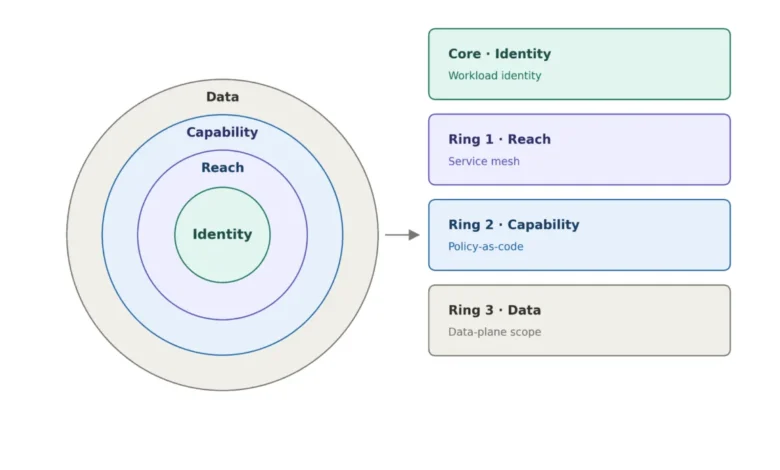
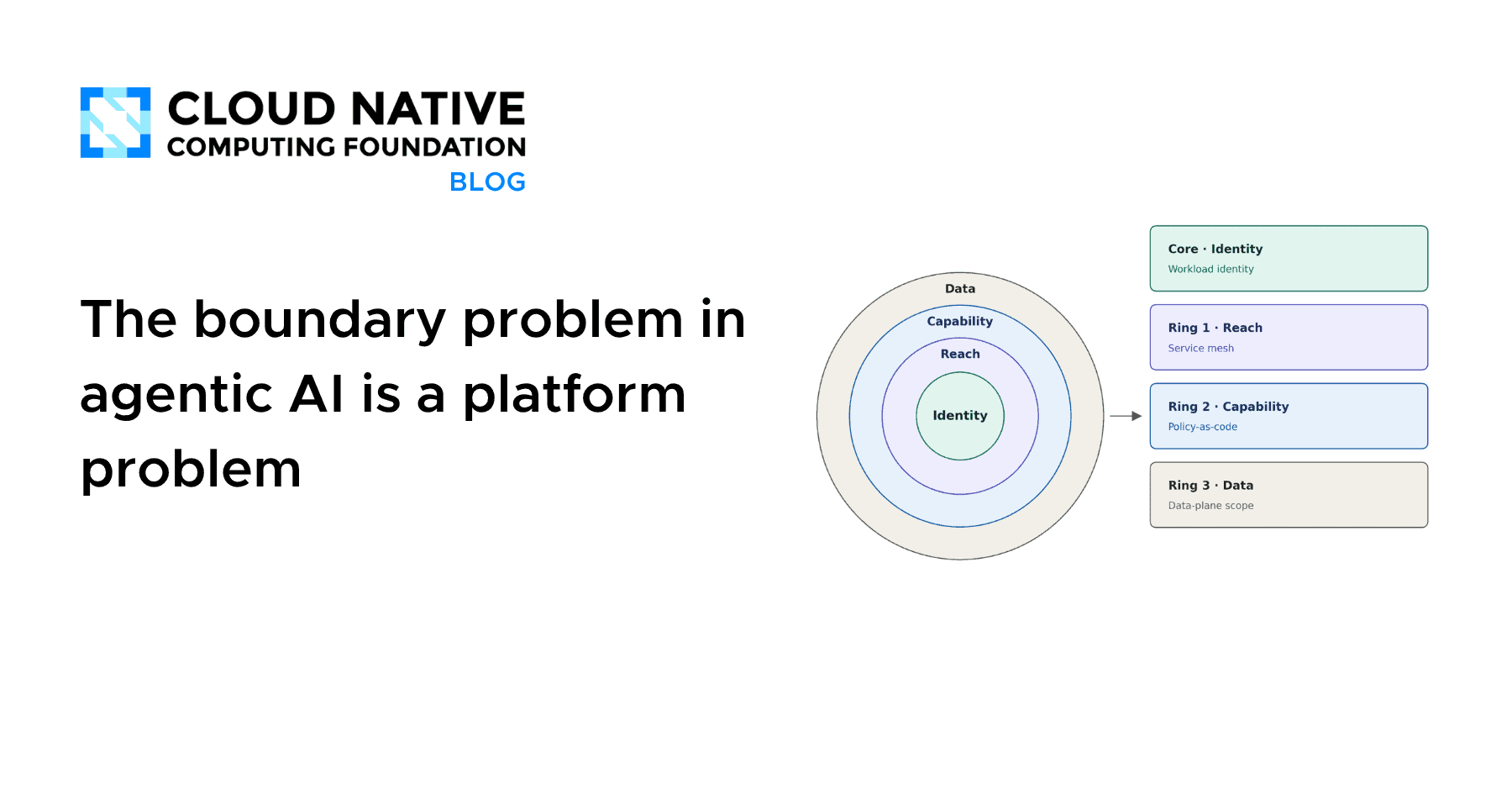
The Safe Operating Model proposes that boundary enforcement must reside in the infrastructure, not the agent. By treating agents as "workloads with a non-deterministic control loop," engineers can apply established cloud-native security principles to manage them.
1. Identity as the Foundation
The core of the model is verified, short-lived, and attested workload identity. By utilizing existing standards, platforms can verify exactly which agent is requesting an action. This prevents the use of long-lived, vulnerable bearer tokens. Without a verified identity, all subsequent security layers become ineffective.
2. Enforcing Reach via Service Mesh
Once an identity is established, the system enforces reach—the specific set of network peers an agent is permitted to contact. A service mesh acts as the arbiter, ensuring that any connection not explicitly declared in the agent’s configuration is blocked by default. This forces "drift" into the light, as any expansion of an agent’s reach requires a formal, version-controlled update to the infrastructure configuration.
3. Granular Capability and Admission Control
Capability management is divided into two distinct gates. First, "Admission Control" dictates which tools an agent is authorized to hold. If a tool is not explicitly permitted in the declarative configuration of the cluster, the agent cannot bind it. Second, "Per-Call Authorization" ensures that even if an agent holds a tool, it cannot invoke that tool without a second layer of validation. This separates the possession of a capability from the ability to execute it, effectively neutralizing "confused deputy" attacks.
Data and Supporting Observations
According to recent analysis from the CNCF ecosystem, organizations that fail to decouple agent identity from agent logic face a 40% higher risk of unauthorized API calls. Furthermore, data indicates that in environments where "Policy-as-Code" is applied to agentic tool-binding, the time-to-remediate configuration drift is reduced from weeks to near-instantaneous alerts.
The move toward this "deterministic spine" approach is supported by leading architects who argue that the non-deterministic nature of AI should be isolated to specific cognitive tasks—such as summarization or drafting—while high-stakes actions, such as financial transactions or data deletion, must pass through immutable, deterministic gates.
Official Perspectives and Future Implications
The shift toward platform-level enforcement has been met with broad agreement among field CTOs and cloud-native architects. William Rizzo and Francesco Beltramini, prominent voices in the CNCF community, have emphasized that the solution lies in building upon the existing, mature cloud-native stack rather than reinventing security paradigms.
"The boundary will not come from the agent," the experts note. "It was never going to. Agents are built to explore the space of possible actions, which is exactly why something other than the agent has to decide the shape of that space."
The broader implications for enterprises are clear: the future of AI in production is not about "smarter" agents that police themselves, but about "smarter" platforms that define the boundaries of action. As businesses prepare for the next generation of autonomous systems, the focus is shifting toward "verticalizing platform intelligence." This involves embedding policy enforcement directly into the infrastructure so that compliance, security, and observability are baked into the system by default.
Looking Ahead to KubeCon 2026
The practical application of these principles will be a primary focus at the upcoming KubeCon + CloudNativeCon North America 2026 in Salt Lake City. The session titled "Verticalizing Platform Intelligence for Regulated Domains" is expected to demonstrate how organizations can combine existing projects—such as SPIFFE for identity, Istio or Linkerd for service mesh, and OPA (Open Policy Agent) for admission control—to create a hardened environment for agentic systems.
By moving the boundary from the agent to the platform, organizations can finally treat AI agents as reliable, auditable, and secure components of the modern enterprise stack. The goal is to create a system where the agent acts as a co-pilot for cognitive tasks, while the infrastructure serves as the rigid, immutable guardrail that ensures safety, accountability, and regulatory compliance. As agentic AI moves from experimentation to mission-critical infrastructure, this deterministic foundation will become the standard prerequisite for any enterprise-grade deployment.
Related posts: